The Danger of Generalization: Why Broad Claims about Magnetic Fields in Vehicles Are Scientifically Flawed
For years, the public has voiced growing concern regarding Non-Ionizing Radiation (NIR), specifically Low-Frequency Magnetic Fields, in modern vehicles. With the surge of Electric Vehicles (EVs), hybrids, and cars packed with sophisticated electronic driver-assistance systems, the question is no longer if there is a magnetic field, but how much exposure passengers are receiving.
In response, several funded studies have attempted to soothe public anxiety. However, these reports often fall into a dangerous trap: the fallacy of generalization. By measuring a handful of models and declaring an entire industry “compliant”, even when the data barely skims the ceiling of the most relaxed standards, these agencies bypass rigorous science in favor of broad, misleading reassurances.
A prime example is a recent press release from the German Federal Office for Radiation Protection (BfS). The agency issued an implied blanket verdict for all electric vehicles based on a study that tested only a small selection of models. While the underlying research, conducted by Seibersdorf Laboratories, was technically excellent and highly professional, the BfS’s subsequent interpretation is deeply flawed. The danger lies in the leap from specific lab results to universal claims. By failing to mention that ICNIRP standards do not address the risks of chronic exposure, and by implying that these specific, filtered results apply to every car on the road, the BfS is providing a dangerously misleading narrative, especially in light of the fact that the actual magnetic fields measured were very high, even if they barely meet the easiest ICNIRP 2010 standards, and even that only after discounting for short bursts. For car owners rightfully concerned about long-term health risks to themselves and their children, claiming “every car is safe” based on a few borderline measurements is not just unscientific, it is an irresponsible generalization that ignores the vast technical differences between vehicle models.
The Myth of the “Representative Sample”
Some reports often conclude that “electric cars are as safe as gasoline cars” based on tests conducted on just one or two models. In any other safety discipline, this would be laughed out of the room.
Imagine if Euro NCAP tested only a few models, found them relatively safe, and then issued a statement saying, “All cars are now safe for collisions; no further testing required.” It sounds absurd because we know that structural integrity varies wildly between manufacturers and models. Magnetic radiation is no different.
Why Generalization Fails: The Physics of the Radiation Sources in Cars
To understand why you cannot generalize, you must understand how these fields are generated. The intensity of a magnetic field follows the inverse-power law decay (the specific exponent depending on current carrying paths geometry). Moving a high-voltage wire harness just a few centimeters closer to or further from the passenger cabin can result in a dramatic shift in exposure levels. Data from rigorous testing bodies, such as China-NCAP, has shown a massive “dynamic range” in magnetic field levels between different models, up to 33 dB (!) and more between models, an almost two orders of magnitude difference.
Even within a single car, radiation is not a static number. It is a highly volatile variable influenced by:
- Vehicle State: Levels spike during heavy acceleration or regenerative braking compared to steady-state cruising.
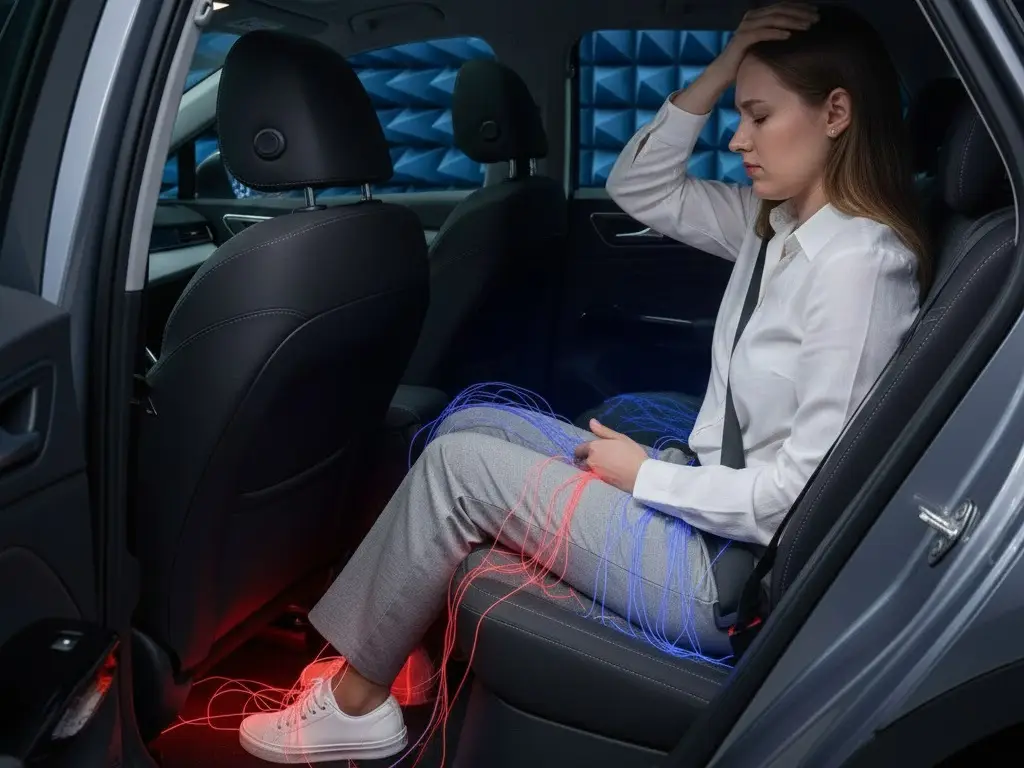
- Spatial Variance: The field level at the driver’s feet might be negligible, while the level in the rear seat (where children often sit) could be significantly higher due to the proximity of the battery or inverter.
- Active Features: Turning on heated seats, high-fidelity sound systems, or climate control can change the electromagnetic profile of the cabin instantly.
A Call for Rigor: The “N-CAP” for Radiation
The public does not accept “general safety” for fuel emissions or crashworthiness; we demand model-specific data. Why should magnetic radiation be treated with less gravity?
When a government agency tells a consumer, “Do not worry about your specific car because we checked a different one three years ago,” they are engaging in irresponsible gatekeeping. This prevents the consumer from making an informed choice and removes the incentive for manufacturers to make design efforts to lower emissions.
The Bottom Line: Generalizing about car radiation is technologically incorrect. Every model, and every configuration of that model, is a unique electromagnetic environment.
References
- Bundesamt für Strahlenschutz (German Federal Office for Radiation Protection) (2025). Radiation protection study: analysed electric cars comply with recommended maximum values for health protection
- Bundesamt für Strahlenschutz (German Federal Office for Radiation Protection) (2025). Bestimmung von Expositionen gegenüber elektromagnetischen Feldern der Elektromobilität (Determination of exposure to electromagnetic fields from electromobility).
- 中国新车评价规程 (C-NCAP) (2021). 更多测评结果 (More test results)