Radiation and Health: What WHO Decision EB158(9) Means for the Public
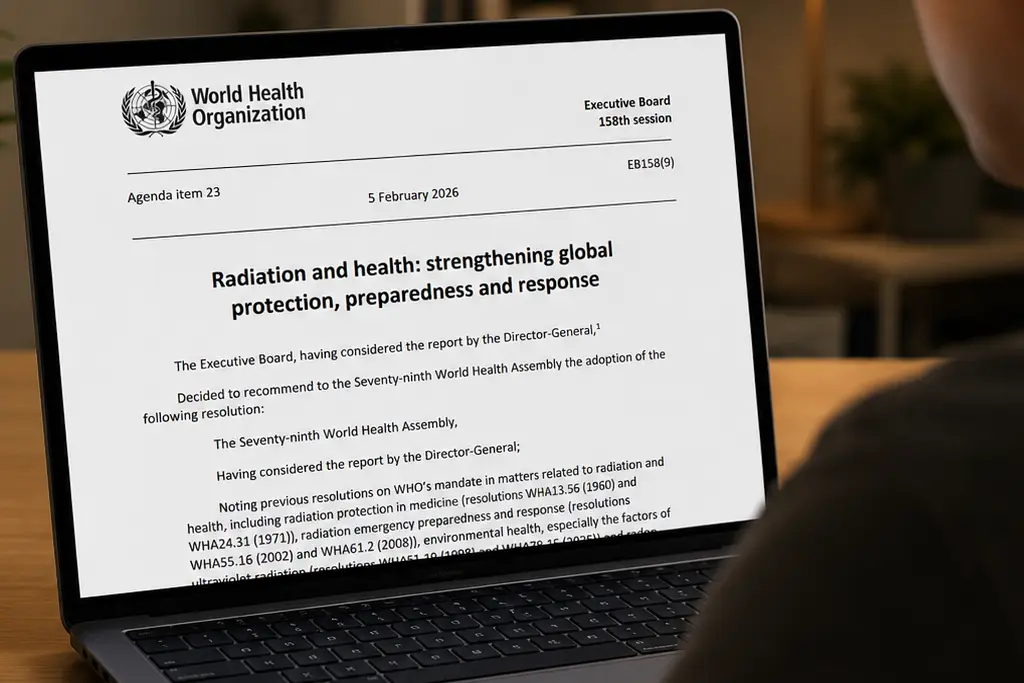
On February 5, 2026, the WHO Executive Board adopted decision EB158(9) about radiation and health, recommending that the Seventy-ninth World Health Assembly adopt a resolution on strengthening global radiation protection, preparedness, and response.
The relevance of this decision is broader. EB158(9) supports the need for public information, exposure monitoring, risk communication, and stronger public-health policies where radiation exposure may occur.
This may also be relevant to vehicles because cars are now electrically intensive environments. Electric vehicles, hybrid vehicles, plug-in hybrids, and even conventional vehicles contain many electrical systems that may create low-frequency magnetic fields inside the passenger cabin.
Radiation and Health Is a Public-health Issue
EB158(9) recognizes widespread global exposure to both ionizing and non-ionizing radiation. It also acknowledges health risks associated with radiation exposure, including short-term and long-term radiation-induced effects.
The decision gives particular attention to children and pregnant women. It also recognizes WHO’s role in providing leadership, evidence-based reviews, and guidance on non-ionizing radiation and human health.
This means radiation and health should not be treated only as a medical, nuclear, or emergency issue. The decision places it within a wider public-health framework that includes environmental and occupational exposure.
The Need for Monitoring
The WHO decision EB158(9) calls on Member States to strengthen national systems for monitoring public, workers’, and patients’ exposure to ionizing and non-ionizing radiation.
It specifically includes electromagnetic fields in this monitoring context. This does not make any statement about cars, but it does support the general principle that electromagnetic-field exposure is a subject that can be monitored and assessed.
Monitoring helps public-health authorities move from assumptions to evidence. It also supports better policies, better communication, and better management of radiation-related health risks.
Public Education and Risk Communication
It also calls for public education, risk communication, and awareness-raising strategies to reduce harmful exposure and improve public understanding of radiation and health issues.
This is relevant for public discussion. Radiation-related subjects can easily be misunderstood. Some people may dismiss the topic completely, while others may become unnecessarily alarmed.
The decision supports a more responsible direction: clear information, better public understanding, and communication based on evidence rather than fear or assumptions.
Public-health Policy and Cooperation
EB158(9) urges Member States to strengthen national strategies, legislation, institutional frameworks, and capacities for radiation protection and health-risk management.
It also calls for international cooperation, sharing of national experiences and best practices, and continued work with relevant international bodies, including organizations involved in ionizing and non-ionizing radiation protection.
This shows that radiation and health is not only a technical subject, but also a policy subject that involves health authorities, regulators, scientific bodies, and public communication.
Why Public Information and Protection Measures Are Important in Cars
While WHO decision EB158(9) does not give vehicle-specific recommendations, its wider public-health direction is relevant to any setting where radiation or electromagnetic-field exposure may be a concern.
For cars, this means the public should have access to clear, evidence-based information rather than assumptions. People should know that radiation and electromagnetic fields are subjects that can be monitored, assessed, and communicated responsibly.
Where vehicle-specific testing identifies differences in electromagnetic-field exposure, the first priority should be making reliable information available to the public. Some governments and organizations have already begun publishing vehicle-specific measurement results. Examples already exist. The Israeli Ministry of Environmental Protection publishes vehicle-specific electromagnetic-field measurement results, while organizations in China also publish measurement results for individual vehicle models. These initiatives give consumers access to measured data rather than assumptions and support more informed public discussion.
Reference
- World Health Organization (WHO) (2026). Radiation and health: strengthening global protection, preparedness and response (Executive Board, 158th session, agenda item 23, EB158(9))
- Israeli Ministry of Environmental Protection (2025). Electromagnetic Field (EMF) Measurements – Summary of Test Results
- China Automotive Engineering Research Institute (CAERI). C-AHI China Automobile Health Index – Vehicle Electromagnetic Radiation (EMR) Evaluation Results