How Vehicle EMF Is Measured by Institutions and Governments
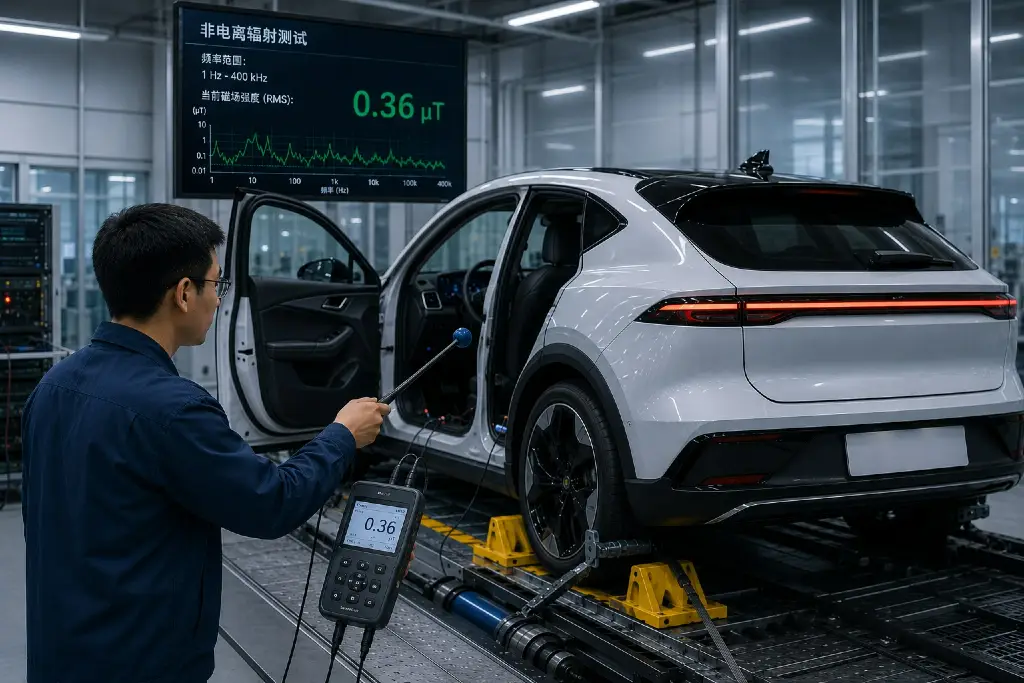
Vehicle EMF measurement focuses on low-frequency magnetic fields in the automotive environment. The measurement process is not only about taking a field reading inside a car. It also requires a defined exposure framework, a recognized vehicle measurement standard, suitable measuring equipment, controlled vehicle setup, defined measurement locations, and specific operating conditions such as stationary mode, driving, dynamic acceleration or deceleration, and plug-in charging.
When institutions, governments, testing bodies, or manufacturers assess vehicle EMF, they generally separate two questions:
- The first is how exposure should be judged, using frameworks such as ICNIRP 1998, ICNIRP 2010, or GB 8702-2014.
- The second is how the magnetic field should be measured inside the vehicle, using automotive measurement standards such as IEC 62764-1, GB/T 37130-2018, or JASO TP-13002.
This distinction is important because exposure limits and measurement methods are not the same. Exposure standards define reference levels and basic restrictions. Vehicle measurement standards define how the car is prepared, where measurements are taken, what electrical loads are turned on, which operating phases are tested, and what type of equipment is used.
Types of Exposure
Low-frequency magnetic-field exposure can be considered in three main ways: acute exposure, chronic exposure, and exposure related to active implantable medical devices.
- Acute exposure means short-term, high-intensity exposure with an immediate biophysical reaction. The mechanism described for acute exposure is the induction of electric fields and currents inside the body, which can interfere with nervous system function. Examples include nerve stimulation and flickering light effects.
- Chronic exposure means long-term, repeated, or continuous exposure to low-intensity fields, with no immediate biophysical reaction. Unlike acute exposure, the biological mechanism is still described as unknown. However, the medical research aspect is still relevant because chronic low-frequency magnetic-field exposure has been associated with concerns involving the neuroendocrine, nervous, reproductive, immunological, and hematological systems. It is also connected to the IARC 2B classification, meaning potentially carcinogenic.
- Active implantable medical devices, or AIMDs, are treated separately. For AIMDs, the concern is electromagnetic interference. ELF magnetic fields can induce electrical currents within conductive loops formed by the implanted device and its leads.
Acute Exposure Standards
The most common acute exposure standards listed are ICNIRP 1998, ICNIRP 2010, and GB 8702-2014.
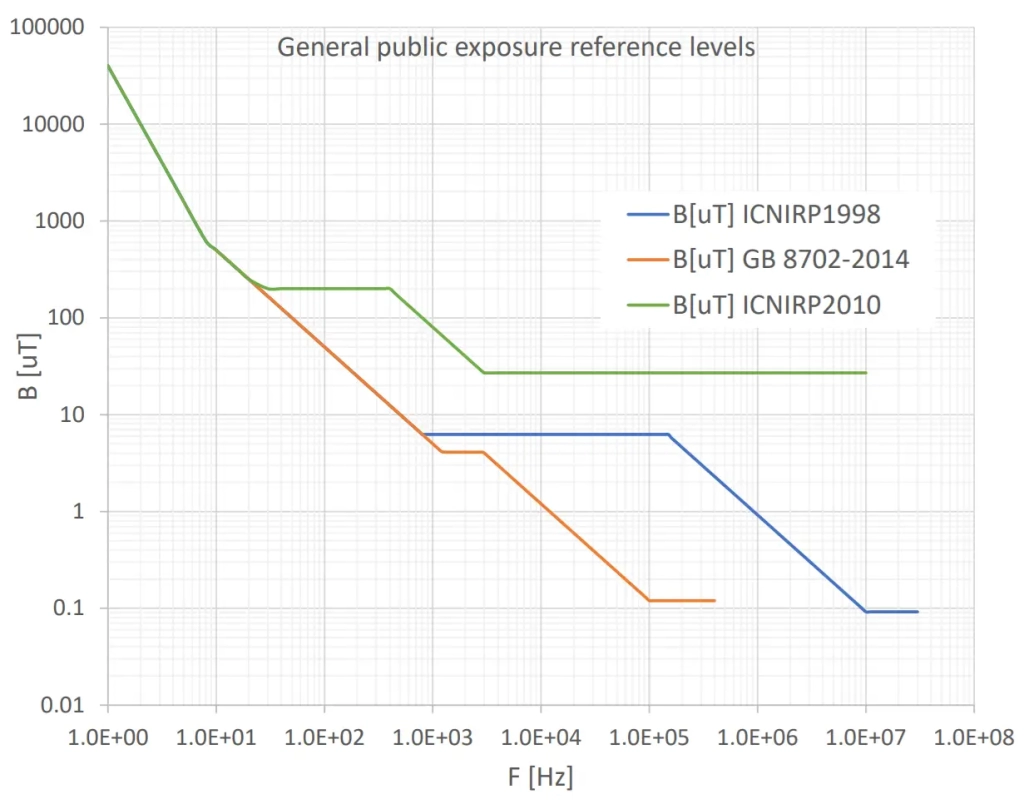
These standards use a two-tier system:
- The first tier is basic restrictions, which are limits on internal physical quantities such as induced current or induced field.
- The second tier is reference levels, which are derived limits on measurable external fields used for practical compliance.
ICNIRP provides exposure limits for both the general public and occupational exposure.
Reference levels have limitations. In uniform fields, compliance with the standard is shown when the measured field is below the reference level. If fields are highly non-uniform or exceed the reference level, exposure is assessed against the basic restrictions.
Spatial averaging is also treated carefully. ICNIRP allows spatial averaging in less localized fields, meaning fields more than 20 cm from the source, but this requires further guidance from standardization bodies. GB 8702-2014 mandates three-point vertical averaging of electric fields, although this is noted as not relevant here.
Chronic Exposure
For chronic exposure, no formal international safety standard exists. The WHO acknowledges the precautionary principle by referencing a 0.4 µT threshold for magnetic fields as a point of concern for potential long-term health risks.
Active Implantable Medical Devices
For active implantable medical devices, ICNIRP 1998 is widely used as the benchmark for AIMD safety. In at least some AIMDs, immunity levels are close to the ICNIRP 1998 reference level.
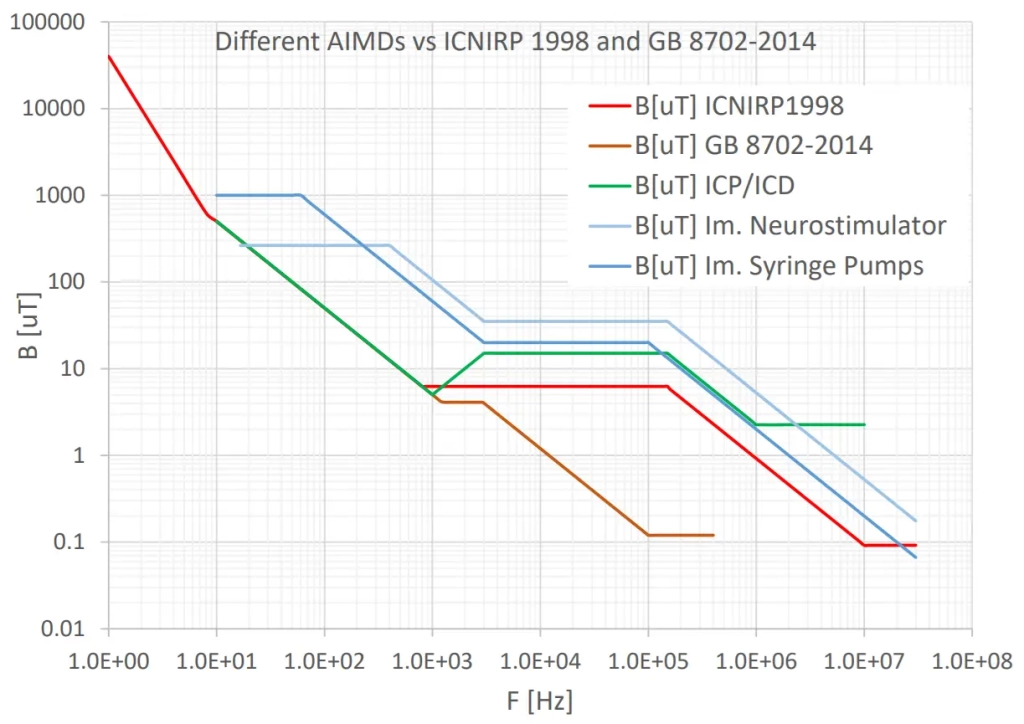
For this case, peak local field-strength values are used. Spatial averaging is not used.
Vehicle Measurement Standards
Several standards are used for measuring low-frequency magnetic fields in the automotive environment:
- IEC 62764-1, used in the EU
- GB/T 37130-2018, used in China
- JASO TP-13002, used in Japan
In addition, every OEM has an internal measurement standard.
These standards differ in measuring equipment, measuring site requirements, additional loads, treatment of transients, tire magnetization, vehicle setup, measurement locations, measurement phases, and what happens if reference levels are exceeded.
Comparing the Standards
The table below compares the main vehicle low-frequency magnetic-field measurement standards. It shows how IEC 62764-1, GB/T 37130-2018, and JASO TP-13002 differ in equipment requirements, test conditions, vehicle setup, measurement locations, operating phases, and treatment of reference-level exceedance.
| IEC 62764-1 | GB/T 37130-2018 | JASO TP-13002 | |
| Measuring equipment | 1Hz-100kHz, probe area <100cm² | 10Hz-400kHz, probe diameter <13cm, weighted measurement in time domain | 10Hz-400kHz, probe diameter <13cm and area = 100 +/-5% cm², weighted measurement in time domain |
| Measuring site | Ambient noise <10% of the limit | Ambient noise <10% of the limit | Ambient noise <5% of the limit |
| Additional loads | Continuous (AC, headlights) or repetitive sources (wipers) | Continuous (AC, headlights) or repetitive sources (wipers) | All sources should be turned on and adjusted to maximum |
| Transients | <200ms ignored | N/A | <200ms ignored |
| Tires magnetization | Only mentioned | Not mentioned | Not mentioned |
| Vehicle set-up |
|
|
|
| Measurement locations |
|
|
|
| Measurement phases |
|
|
|
| If reference level exceeded | “Further investigation is required” | N/A | Calculate coupling factors, if still fails evaluation against basic restrictions |
So Which Standard Should Be Used?
Our recommendation is to use IEC 62764-1 as the basis, with several changes.
- Avoid probe-distance constraints and instead consider probe size against uncertainty. This point is connected to the BfS study.
- Consider including transients shorter than 200 ms, in light of the BfS study findings.
- Recognize that scanning the entire volume during the dynamic stage is not feasible. One proposed alternative is emulation of dynamic load by constant high load on a dynamometer.
- Consider using higher acceleration and deceleration rates than 2.5 m/s². This point is also connected to the BfS study.
Measurement Equipment
The table below lists examples of measurement equipment used for low-frequency magnetic-field measurement. It includes the frequency range, measurement ranges, noise level, analysis methods, probe diameter, and price for each instrument.
| NARDA EHP-50F | WAVECONTROL WP400c | NARDA BFD-400-1 | |
| Frequency range [Hz] | 1-400,000 | 1-400,000 | 1-400,000 |
| Measurement Ranges [mG] | 0.003-1000
0.3-100,000 |
0.5-300,000 (50Hz)
0.5-15,000 |
800, 8000, 80000, 800000 |
| Measurement | Instantaneous | Instantaneous | Instantaneous |
| Noise level [mG] | 0.003 | <0.5 | 0.38, 3.5, 32, 300 |
| Spectrum analysis method | FFT | FFT | FFT |
| Time domain analysis method and standards | ICNIRP 1998, 2010 and 2013/35/EU weighed peak analysis | EU Directive 2013/35/EU, IEEE (except Restricted and Limb), ICNIRP, BGV B11, GB 8702-2014, weighed peak | 2013/35/EU, ICNIRP1998, ICNIRP2010, EMFV2016, GB8702, TREMF, IEEE C95 weighed peak…. |
| Probe diameter [cm] | 6.67 | 11.3 | 12.5 |
| Price [$] | 10,000 | 8,700 (SMP3 included) | N/A |
Main Points on Vehicle EMF Measurement
Vehicle low-frequency magnetic-field measurement is a structured process based on exposure categories, exposure standards, vehicle-specific measurement standards, defined vehicle setup, measurement locations, operating phases, electrical loads, ambient noise requirements, probe characteristics, and measurement equipment.
The standards for vehicle measurement are IEC 62764-1, GB/T 37130-2018, and JASO TP-13002. IEC 62764-1 is recommended as the basis, with changes related to probe-distance constraints, short transients, dynamic-stage feasibility, dynamometer use, and stronger acceleration and deceleration rates.
References
- International Commission on Non-Ionizing Radiation Protection (ICNIRP) (1998). Guidelines for limiting exposure to time-varying electric, magnetic and electromagnetic fields (up to 300 GHz)
- International Commission on Non-Ionizing Radiation Protection (ICNIRP) (2010). Guidelines for limiting exposure to time-varying electric and magnetic fields (1 Hz to 100 kHz)
- International Electrotechnical Commission (IEC) (2022). IEC 62764-1:2022: Measurement procedures of magnetic field levels generated by electronic and electrical equipment in the automotive environment with respect to human exposure – Part 1: Low-frequency magnetic fields
- State Administration for Market Regulation (SAMR) and Standardization Administration of China (SAC) (2018). GB/T 37130-2018: Measurement methods for electromagnetic fields of vehicle with regard to human exposure
- Society of Automotive Engineers of Japan (JSAE) (2013). TP13002: Measurement methods for electromagnetic field of vehicles with regarding to the human exposure
- Bundesamt für Strahlenschutz (BfS) (2025). Bestimmung von Expositionen gegenüber elektromagnetischen Feldern der Elektromobilität: Ergebnisbericht – Teil 1: Elektromagnetische Felder beim Fahren (Determination of exposures to electromagnetic fields from electromobility: Final report – Part 1: Electromagnetic fields while driving)